

Best Vitamins for Macular Health: What AREDS2 Really Means
“AREDS2” has become shorthand for eye vitamins, but it should not be. AREDS2 refers to a specific formula, tested in a specific group of people, for a specific outcome: reducing progression of age-related macular degeneration in people already at higher risk.
That precision matters. A general eye-support supplement can contain useful nutrients without being an AREDS2 formula, and AREDS2 is not appropriate for every person who wants to protect their sight.
Start with the condition, not the bottle
Age-related macular degeneration, or AMD, affects the macula—the central part of the retina used for reading, recognizing faces, and seeing fine detail. Eye doctors classify AMD by findings seen on a dilated retinal exam and imaging, not by symptoms alone.
Early AMD may cause no noticeable vision change. Intermediate AMD involves more extensive deposits called drusen or pigment changes. Late AMD can involve abnormal blood vessels or loss of retinal tissue.
That is why an online symptom quiz cannot tell someone whether AREDS2 is indicated. The decision begins with a dilated eye examination.
The exact AREDS2 formula
According to the National Eye Institute, the studied daily formula contains:
- Vitamin C: 500 milligrams
- Vitamin E: 400 IU
- Zinc: 80 milligrams
- Copper: 2 milligrams
- Lutein: 10 milligrams
- Zeaxanthin: 2 milligrams
- No beta-carotene
Copper was included to reduce the risk of copper deficiency from high-dose zinc. Lutein and zeaxanthin replaced beta-carotene because beta-carotene increased lung-cancer risk in current and former smokers.
An eye supplement with different ingredients or doses is not the exact AREDS2 formula. Similar-looking front-label language does not change that.
What the famous 25% actually means
The National Eye Institute reports that AREDS or AREDS2 reduced the risk of progression from intermediate to advanced AMD by about 25 percent in higher-risk participants.
This is a relative risk reduction over the study period—not a guarantee of stable vision and not a 25-percentage-point benefit for every user. The formula did not prevent AMD from starting, did not stop early AMD from becoming intermediate AMD, and did not treat cataracts.
Omega-3 fatty acids were tested in AREDS2 and did not add protection against AMD progression in the trial. Omega-3s may have other nutritional roles, but they are not part of the proven AREDS2 effect.
Who may benefit
AREDS2 is generally considered for people with intermediate AMD in one or both eyes, or late AMD in one eye with the other eye still at risk. An ophthalmologist or optometrist should confirm the stage and recommend the formula.
People with no AMD or only early AMD do not get the same evidence-backed benefit from taking AREDS2. For them, smoking avoidance, blood-pressure and cardiovascular care, physical activity, a nutrient-rich diet, and regular dilated exams are more fundamental.
Sudden distortion, a dark central spot, rapidly blurred central vision, flashes, a curtain-like shadow, or a new shower of floaters needs prompt eye care—not another supplement.
Where Nutrovell Macular Complex fits
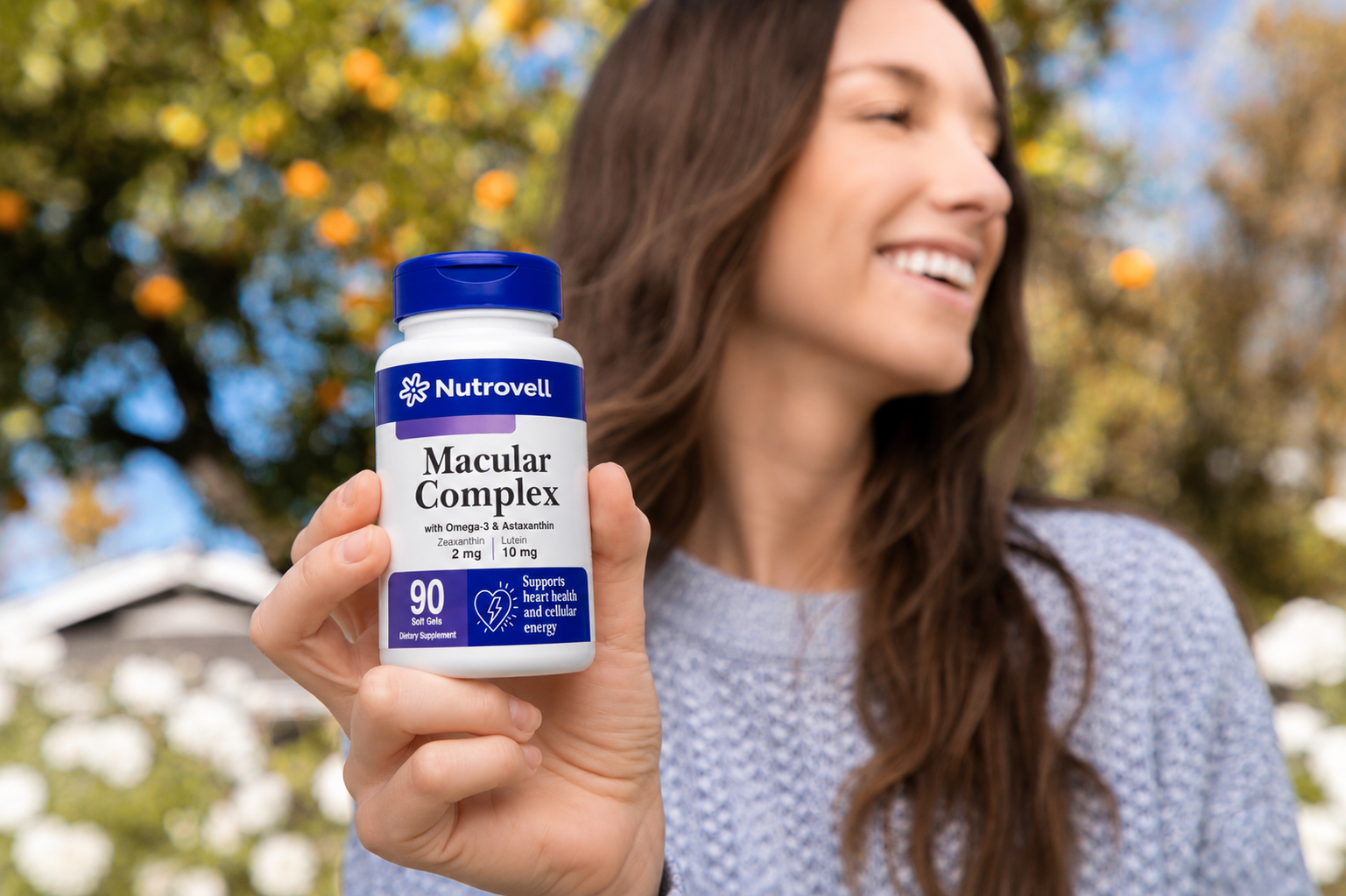
Nutrovell Macular Complex provides 10 milligrams of lutein and 2 milligrams of zeaxanthin per two-softgel serving, along with astaxanthin, omega-3 EPA and DHA, zinc, copper, vitamins C and E, and hyaluronic acid.
This is a broad eye-nutrition formula. It is not the exact AREDS2 formula because several doses differ and it includes additional ingredients. It should not be represented as a substitute when an eye doctor has specifically prescribed an AREDS2 formula.
The honest way to compare them is line by line: ingredient, amount, intended use, and evidence.
Food still matters
Lutein and zeaxanthin are found in dark leafy greens, corn, egg yolks, pistachios, and other foods. Fish contributes EPA and DHA. Diet also supplies fiber and thousands of compounds that a capsule does not reproduce.
Supplements can fill a defined role, but they should sit on top of—not replace—a pattern of vegetables, fruit, legumes, whole grains, nuts, and fish when appropriate.
Safety deserves attention
High-dose vitamins and minerals can interact with medicines and may be inappropriate in some medical conditions. Vitamin E can be relevant to bleeding risk, and zinc can cause nausea or interact with certain antibiotics. Fish-derived ingredients matter for allergies and anticoagulant plans.
Bring the actual Supplement Facts panel to the eye appointment. “I take an eye vitamin” is not enough information when formulas vary widely.
The bottom line
The best vitamin for macular health depends first on the eye diagnosis. AREDS2 is an exact, high-dose formula with evidence for slowing progression in specific stages of AMD—not a universal vision preventive.
Nutrovell Macular Complex is a different, broader nutritional formula. Use each product according to what it actually contains, and let a dilated eye exam guide disease-specific care.
Related Product

Featured in this article
Macular Complex
Omega-3, lutein, zeaxanthin and astaxanthin formula
View ProductReferences
- National Eye Institute. AREDS/AREDS2 Clinical Trials: Major Findings.
- National Eye Institute. AREDS 2 Supplements for Age-Related Macular Degeneration.
- National Eye Institute. Age-Related Macular Degeneration.
These statements have not been evaluated by the Food and Drug Administration. This product is not intended to diagnose, treat, cure, or prevent any disease.
Related Articles

AREDS2 Formula vs. General Eye Vitamins: What's the Difference?

How to Support Liver Health Naturally—Without Detox Myths
