

Lutein and Zeaxanthin Benefits for Eye Health: What the Research Shows
Lutein and zeaxanthin are plant pigments that end up in an extraordinary place: the center of the retina. Together with meso-zeaxanthin, they form macular pigment in the region responsible for detailed central vision.
That biology supports a legitimate eye-health story. The clinical story is narrower. Lutein and zeaxanthin are part of the AREDS2 formula used for people with certain stages of age-related macular degeneration (AMD); they have not been proven to prevent every eye disease or protect healthy eyes from unlimited screen time.
What macular pigment does
The macula contains a dense concentration of these carotenoids. They absorb some short-wavelength visible light and act as antioxidants in a tissue exposed to oxygen and light.
Macular pigment optical density can increase with dietary or supplemental lutein and zeaxanthin in some people. A higher measurement is a biological change, not automatically proof of better vision or prevention of disease.
What AREDS2 actually found
The original AREDS formula reduced progression to advanced AMD in people at high risk. AREDS2 tested whether adding lutein/zeaxanthin and omega-3 fatty acids improved the formula and whether these carotenoids could replace beta-carotene.
Adding lutein and zeaxanthin did not produce a statistically significant benefit in the primary overall analysis. Secondary analyses suggested benefit in participants with low dietary intake and showed that replacing beta-carotene with lutein/zeaxanthin was at least as effective and safer for current and former smokers.
Long-term analyses support the AREDS2 formula for appropriate AMD patients. It does not prevent AMD from starting and is not recommended simply because someone is older or uses a computer.
Food sources matter
Dark leafy greens such as kale, spinach, and collards are rich sources. Egg yolks provide smaller amounts in a fat-containing matrix that may aid absorption. Corn, peas, broccoli, orange peppers, and pistachios also contribute.
Carotenoids are fat-soluble. Eating these foods with olive oil, nuts, eggs, avocado, or another fat can improve absorption. The dietary pattern also supplies fiber and nutrients a softgel cannot reproduce.
Where Nutrovell Lutein + Zeaxanthin fits
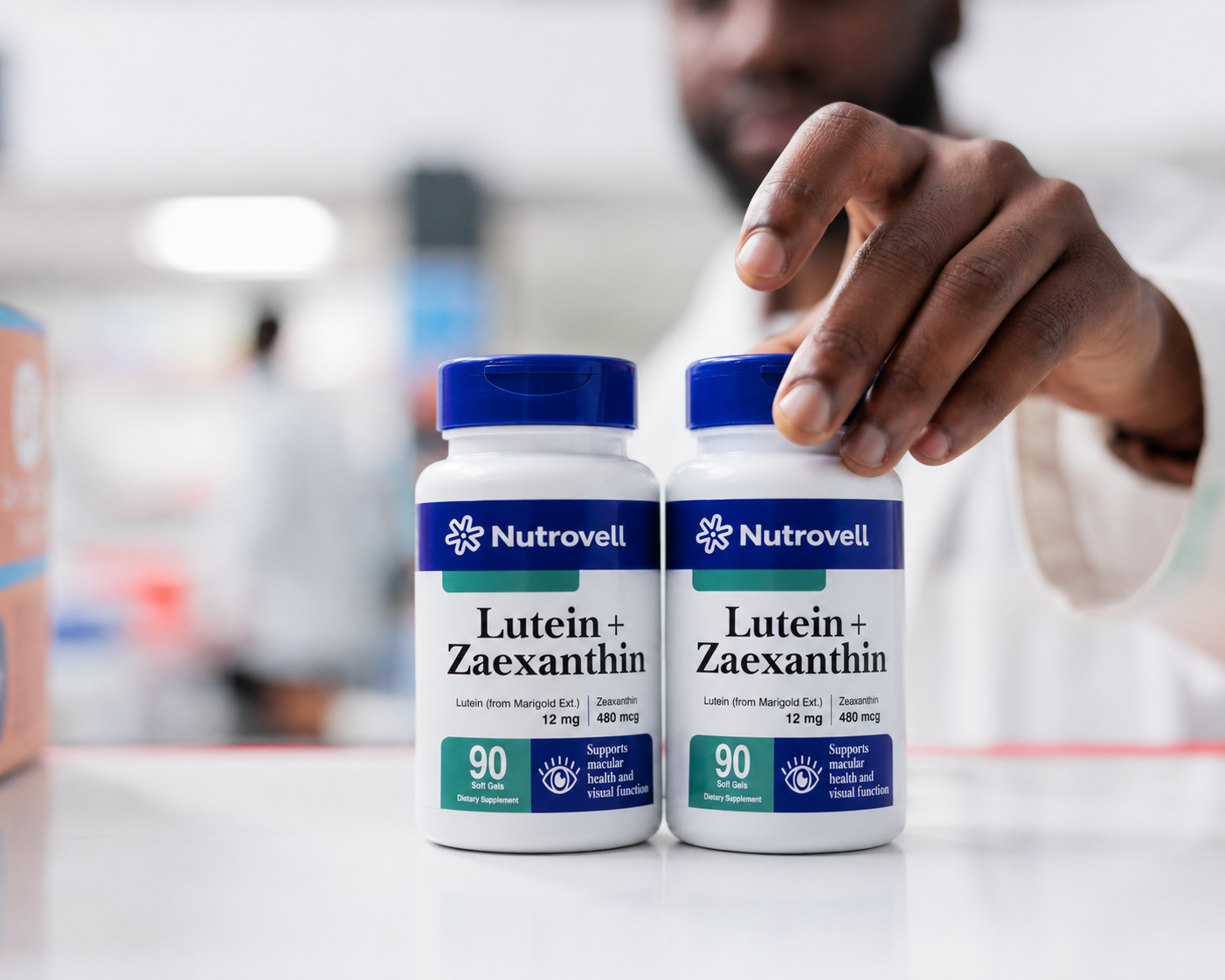
Nutrovell Lutein + Zeaxanthin uses marigold-derived carotenoids in a daily softgel format. The formula is designed for general macular and visual wellness. Check the current Supplement Facts panel for the exact amounts and serving.
Do not assume it is an AREDS2 formula. AREDS2 contains specific amounts of vitamin C, vitamin E, zinc, copper, lutein, and zeaxanthin. A two-ingredient product has a different purpose.
If an eye professional recommends AREDS2 for diagnosed intermediate AMD or advanced AMD in one eye, use a formula that matches the studied composition unless instructed otherwise.
Supplements do not replace eye exams
AMD, glaucoma, diabetic eye disease, cataract, retinal tears, and other conditions can progress without obvious early symptoms. Dilated exams are especially important with diabetes, family history, high blood pressure, age-related risk, or new vision changes.
Sudden distortion, a dark central area, flashes, a shower of floaters, a curtain over vision, or sudden vision loss needs urgent eye care.
Safety and quality
Lutein and zeaxanthin are generally well tolerated. Very high carotenoid intake can color the skin yellow-orange without yellowing the eyes, but any new discoloration should be assessed rather than self-diagnosed.
Pregnancy, breastfeeding, cancer treatment, and significant medical conditions warrant a label review. Tell the eye doctor about every supplement.
The bottom line
Lutein and zeaxanthin are genuine macular pigments with antioxidant and light-filtering roles. Their strongest clinical use is within the AREDS2 formula for people at specified AMD stages.
For general wellness, prioritize leafy greens, colorful vegetables, eggs, and comprehensive eye care. A transparent lutein-zeaxanthin softgel can support the routine without becoming a promise to preserve vision.
Related Product

References
- National Eye Institute. Age-Related Eye Disease Studies (AREDS/AREDS2).
- AREDS2 Research Group. Lutein + zeaxanthin and omega-3 fatty acids for AMD. JAMA. 2013;309(19):2005–2015.
- American Academy of Ophthalmology. Nutrition and Eye Health.
These statements have not been evaluated by the Food and Drug Administration. This product is not intended to diagnose, treat, cure, or prevent any disease.
Related Articles

Do Lutein and Zeaxanthin Protect Your Eyes From Blue Light?

Ferrous Gluconate vs. Ferrous Sulfate: Which Iron Form Is Better?
