

Lutein and Zeaxanthin: Why Are These Macular Pigments Taken Together?
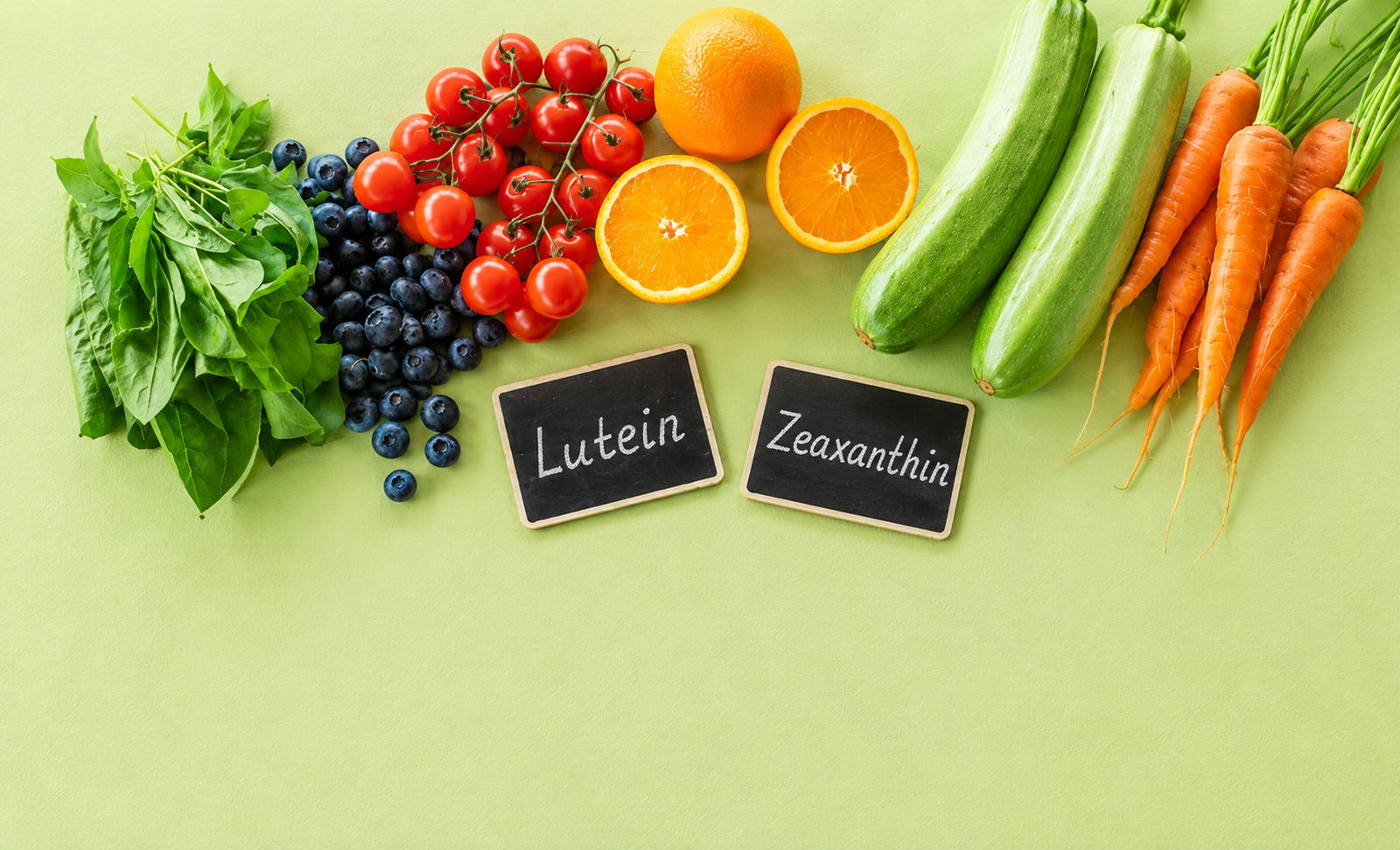
Lutein versus zeaxanthin is the wrong contest for a softgel containing both. The eye selectively accumulates these closely related carotenoids in macular pigment, and they are commonly studied and formulated as a pair.
Their chemical similarity explains the partnership. Their slightly different distribution in the retina explains why both are worth discussing.
Same family, different orientation
Lutein and zeaxanthin are xanthophyll carotenoids—colorful plant compounds containing oxygen. They are structural isomers, meaning they share a formula but arrange double bonds differently.
That difference influences how they orient in cell membranes and interact with light and reactive molecules. Zeaxanthin is more concentrated toward the center of the macula, while lutein is relatively more prominent toward the periphery. Meso-zeaxanthin, formed partly from lutein in the retina, is also concentrated centrally.
The distribution is not evidence that one is “for central vision” and the other is optional. Together they create the macular pigment profile.
Why plants make the partnership possible
Humans cannot synthesize lutein or zeaxanthin from scratch. Food supplies them. Leafy greens are especially rich in lutein; orange peppers, corn, egg yolks, and other foods contribute zeaxanthin and lutein in varying proportions.
Absorption depends on the food matrix, dietary fat, digestion, and genetics. Chopping and cooking can release carotenoids from plant cells, while a modest amount of fat aids absorption.
What the pair does in the eye
Macular pigment absorbs some blue-violet visible light before it reaches photoreceptors and can help manage oxidative stress. These are normal physiological roles.
They do not mean a supplement functions as internal sunglasses, blocks all blue light, or makes unsafe light exposure harmless. The eye needs visible light for vision and circadian signaling.
The AREDS2 reason they appear together
AREDS2 used 10 milligrams of lutein and 2 milligrams of zeaxanthin as a replacement option for beta-carotene in the full AREDS formula. The pair proved safer for current and former smokers because beta-carotene supplements increased lung-cancer risk in those groups.
The full AREDS2 formula is for people with intermediate AMD or advanced AMD in one eye, based on eye-professional guidance. A standalone lutein-and-zeaxanthin product is not equivalent.
The Nutrovell formula
Nutrovell Lutein + Zeaxanthin provides both marigold-derived carotenoids in softgels. Pairing them reflects their natural co-location in macular pigment and the way research commonly studies them.
Check the current label for exact amounts and serving size. Take it with a meal as directed; dietary fat supports carotenoid absorption. Do not stack it automatically with an AREDS2 product, which may already provide both.
This replaces the misleading question “lutein vs. zeaxanthin.” The product is designed around their partnership.
Who needs a different eye product?
Someone with diagnosed AMD should ask whether AREDS2 is indicated. Someone with diabetes needs retinal screening and glucose, blood-pressure, and lipid management. Someone with dry eye or digital eye strain needs a different assessment.
No carotenoid formula treats glaucoma, cataract, retinal detachment, or sudden vision loss.
The bottom line
Lutein and zeaxanthin are taken together because the macula uses both. They share antioxidant and light-filtering roles while occupying somewhat different retinal regions.
The combination is biologically coherent and research-informed. Its value should remain tied to normal macular support—not a competition, cure, or substitute for eye care.
Related Product

References
- National Eye Institute. AREDS/AREDS2 Frequently Asked Questions.
- Bernstein PS, et al. The value of measurement of macular carotenoid pigment. Progress in Retinal and Eye Research. 2016.
- AREDS2 Research Group. JAMA. 2013;309(19):2005–2015.
These statements have not been evaluated by the Food and Drug Administration. This product is not intended to diagnose, treat, cure, or prevent any disease.
Related Articles

Do Lutein and Zeaxanthin Protect Your Eyes From Blue Light?

How Long Do Probiotics Take to Work? Signs to Watch and What to Expect
