

Do Women Need a Daily Multivitamin? Benefits, Limits, and Life-Stage Needs
“For women” sounds like one nutritional category. It is not. A 24-year-old training for a marathon, a 36-year-old planning pregnancy, a 52-year-old entering menopause, and a 70-year-old with reduced appetite can have very different needs.
A daily multivitamin can be useful when it fills the gaps created by that real life. It becomes less useful when it is treated as a universal requirement or a substitute for food, screening, and medical care.
What a multivitamin can realistically do
A multivitamin can increase intake of vitamins and minerals that are inconsistent in the diet. That may be valuable when meals are restricted, appetite is low, food access varies, or several food groups are regularly absent.
It cannot guarantee more energy, stronger immunity, healthier hair, or prevention of heart disease or cancer. Trials of multivitamin/mineral supplements have mixed results, and formulas differ widely. The most defensible benefit is improved nutrient coverage.
Menstruation changes the iron question
Menstruating women need more dietary iron than adult men and postmenopausal women because blood loss removes iron. Heavy periods, frequent blood donation, pregnancy, limited iron-rich food, or digestive conditions can increase risk.
That does not mean every tired woman should start iron. Iron deficiency is evaluated with history and blood tests, often including a complete blood count and ferritin. Excess iron causes gastrointestinal problems and can be harmful.
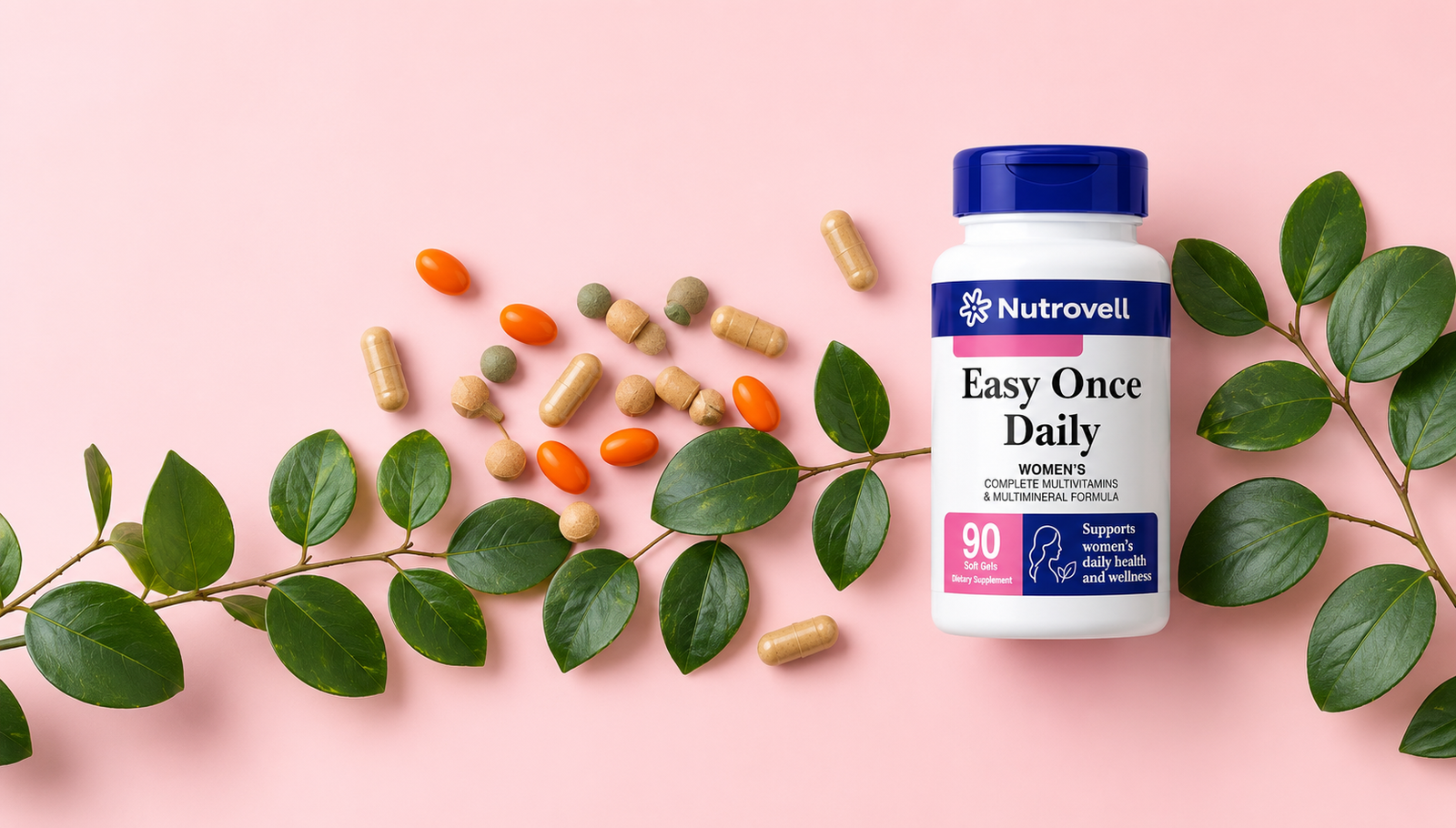
Nutrovell Easy Once Daily Women includes iron among 21 nutrients. Count other iron products, and keep any iron-containing bottle away from children; accidental overdose can be fatal.
Pregnancy plans require a different conversation
Anyone who could become pregnant needs adequate folic acid before conception and during early pregnancy because the neural tube closes very early—often before pregnancy is recognized. Prenatal needs also involve iron, iodine, choline, vitamin D, and other nutrients.
A general women's multivitamin should not automatically be used as a prenatal. The folate amount, vitamin A form, iodine, iron, and other ingredients may differ. Pregnancy planning is a reason to review the exact label with an obstetric clinician.
After menopause, priorities shift
After menstrual blood loss ends, routine iron needs fall. Bone and muscle health become increasingly important as estrogen changes accelerate bone loss. Calcium, vitamin D, protein, resistance training, weight-bearing movement, and fall prevention all matter.
One softgel may contain vitamin D and some calcium or magnesium, but bulky minerals rarely fit in large amounts. Read the milligrams instead of assuming presence equals adequacy.
Postmenopausal women should not keep taking high-iron products indefinitely simply because they are labeled “women's.” Health history and laboratory results matter more than gender branding.
Women over 50 should pay attention to B12
Vitamin B12 supports red blood cell formation and neurological function. With age, reduced stomach acid can make food-bound B12 harder to release. Metformin and long-term acid-suppressing medicines can also affect status.
Fortified foods and supplements provide B12 in a form that does not require the same initial food-release step. Numbness, balance changes, memory symptoms, anemia, or persistent fatigue deserve evaluation.
How to read the 21-nutrient formula
Nutrovell Easy Once Daily Women supplies vitamins A, C, D, E, K, B vitamins, folic acid, biotin, and several minerals in one daily softgel. The broad coverage is convenient, but the details decide whether it fits.
Check the amount and form of each nutrient. Review vitamin D, folate, iron, B6, B12, zinc, and vitamin A across all products. A beauty gummy, immune powder, and multivitamin may quietly overlap.
Vitamin K intake needs coordination with warfarin. Minerals can affect absorption of thyroid medicine and certain antibiotics. Kidney disease, iron overload, and pregnancy change the safety calculation.
Food remains the main formula
Legumes, leafy greens, fruit, dairy or fortified alternatives, eggs, fish, whole grains, nuts, seeds, and lean proteins provide more than isolated vitamins. They supply fiber, protein, essential fats, and phytochemicals that no softgel reproduces.
Use the multivitamin to support the pattern, not excuse it. If the diet consistently lacks one food group, ask whether food, fortification, or a targeted supplement is the better repair.
The bottom line
Women do not need a multivitamin simply because they are women. Some benefit from the convenience and coverage, while others meet needs through food or require a more targeted plan.
The useful decision follows life stage: menstrual losses, pregnancy plans, menopause, age, medicines, and diet. Choose the label that answers those needs rather than the one with the broadest promises.
Related Product

Featured in this article
Women's Once Daily Multivitamin
Daily vitamin and mineral support for women
View ProductReferences
- National Institutes of Health, Office of Dietary Supplements. Multivitamin/mineral Supplements: Fact Sheet for Health Professionals.
- National Institutes of Health, Office of Dietary Supplements. Iron, Folate, Vitamin B12, Calcium, and Vitamin D Fact Sheets for Health Professionals.
- National Institute on Aging. Vitamins and Minerals for Older Adults.
These statements have not been evaluated by the Food and Drug Administration. This product is not intended to diagnose, treat, cure, or prevent any disease.
Related Articles

Women's Multivitamin vs. Prenatal Vitamin: What's the Difference?

Ubiquinone vs. Ubiquinol: Which Form of CoQ10 Is Better?
